
I am often struck by those who think traditional Christian beliefs are irrational or silly, but simultaneously maintain a worldview for which there is little evidence. Or one that just a few decades ago would have been seen as fringe, kooky, or naïve.
For example, I recall pressing an intelligent friend of mine—who used to be a devout Christian yet now identifies as an agnostic—to provide me with her grand theory on humanity and the universe. She answered with something to the effect of, “I tend to think we are all parasites sucking the life flow out of the earth.” Or, just the other day, my hygienist described herself as spiritual but not religious—a popular term nowadays—the SBNRs.
Views such as these that are atypical historically are not limited to the Nones—a relatively new term to describe people with no religious affiliation. Rather, they are now held by a significant number of self-identifying Christians.
This may come as a surprise to some. “We are a Christian nation,” many of us declare. And on some level, that is true. See David Mark Hall’s “Did America Have a Christian Founding?” for example. Well-known pastor Robert Jeffress recently preached a sermon titled, “America is a Christian Nation,” declaring that “America is—and always has been—a Christian nation.” Or Google the search terms “the most Christian nation in the world,” and you will see the following atop the search results:
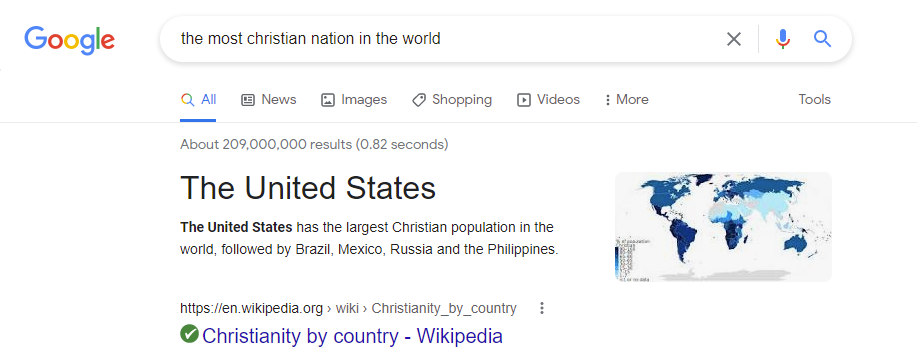
But U.S. “Christianity” is increasingly taking on a hybrid nature. Now, many tend to think that religious syncretism (i.e., the blending of two or more belief systems) is restricted to the likes of the Caribbean (e.g., Rastafarianism), parts of Africa (e.g., Vodou) and Asia, and other less developed areas. Meanwhile, westerners fit into nice, neat categories we tell ourselves: Catholics and Protestants and, to a lesser extent, Jews, Muslims, and atheists and agnostics.
But not so fast. The evidence suggests otherwise. According to a recent Pew Research Center study titled, “‘New Age’ beliefs common among both religious and nonreligious Americans”:
roughly six-in-ten American adults accept at least one of these New Age beliefs [including reincarnation, astrology, psychics and the presence of spiritual energy in physical objects like mountains or trees]. Specifically, four-in-ten believe in psychics and that spiritual energy can be found in physical objects, while somewhat smaller shares express belief in reincarnation (33%) and astrology (29%).
That can’t be right, can it? According to a recent Pew religious landscape study, 65% of Americans still identify as Christian. How can six-in-ten Americans accept New Age beliefs, then? That adds up to no less than 125%, not even factoring in other religions or beliefs.
Pew elaborates:
While eight-in-ten Christians say they believe in God as described in the Bible, six-in-ten [Christians] believe in one or more of the four New Age beliefs analyzed here, ranging from 47% of evangelical Protestants to roughly seven-in-ten Catholics and Protestants in the historically black tradition.
In helping its readers to understand these New Age beliefs, Pew links to Britannica’s New Age movement page, which defines it as a:
a movement that spread through the occult and metaphysical religious communities in the 1970s and ʾ80s. . . . The movement’s strongest supporters were followers of modern esotericism, a religious perspective that is based on the acquisition of mystical knowledge and that has been popular in the West since the 2nd century AD, especially in the form of Gnosticism.
Per Britannica, its ideas include:
First, . . . a New Age of heightened spiritual consciousness and international peace would arrive and bring an end to racism, poverty, sickness, hunger, and war. . . . Second, . . . . a foretaste of the New Age through their own spiritual transformation. Initial changes would put the believer on the sadhana, a new path of continual growth and transformation.
Pew’s findings are less surprising when considering that the percentage of religiously unaffiliated (the Nones) has increased from 16% to 26% from 2007 to 2019. That is a remarkable spike like this country has never seen before. The percentage of self-identifying Christians dropped from 78% to 65% over that same time. In 1990, 85% of Americans identified as Christians per Wikipedia. In 1960, that figure was 92% according to Gallup.
According to a study released by non-partisan PRRI (Public Religion Research Institute) in 2021, “the share of the [U.S.] population identifying as white evangelical [dropped] from 23 percent in 2006 to 14.5 percent [in 2020].”
Pew’s and PRRI’s research comports with that of various Christian polling groups. In 2015, OmniPoll conducted a study that found that just 17% of practicing Christians have a biblical worldview—as defined by The Barna Group, an evangelical polling firm in California.
Barna defined “biblical worldview” to simply include beliefs that (1) there is absolute moral truth; (2) the Bible is inerrant in all the principles it teaches; (3) Satan is a real figure, not symbolic; (4) a person cannot earn their way to heaven; (5) Jesus lived a sinless life; and (6) God is an all-knowing, all-powerful creator of the world who still rules the universe today. This definition is what C.S. Lewis might describe as Mere Christianity. How is it that just 17% of practicing Christians held to these beliefs?
Barna had previously conducted a study in 2003 that found that while 51% of U.S. adults claimed to possess a biblical worldview, just 4% did.
In 2017, Barna conducted another study among Christians to gauge “how much of the tenets of other key worldviews—including new spirituality, secularism, postmodernism and Marxism—have influenced [their] beliefs.” The results were summarized as follows:
61% agree with ideas rooted in New Spirituality.
54% resonate with postmodernist views.
36% accept ideas associated with Marxism.
29% believe ideas based on secularism.
With respect to New Spirituality, Barna found that almost 30% of practicing Christians believe that “all people pray to the same god or spirit, no matter what name they use for that spiritual being” and that “meaning and purpose come from becoming one with all that is.” In summary, over 60% “of practicing Christians embrace at least one of the ideas rooted in New Spirituality.”
With respect to Post-Modernism, 37% of practicing Christians under the age of forty-five believe that “what is morally right or wrong depends on what an individual beliefs.” Twenty-nine percent believed that “if your beliefs offend someone or hurt their feelings, it is wrong.” (How the heck do you reconcile those two beliefs?).
With respect to Marxism, 30% of practicing Christians under forty-five years old believe that “the government, rather than individuals, should control as much of the resources as necessary to ensure that every gets their fair share.”
Earlier this year, Arizona Christian University’s Cultural Research Center conducted an extensive study that found that while 69% of Americans identify as Christians and 35% identify as born again Christians, just 6% have a biblical worldview (defined as being similar to the above).
Of the 6%, a significant number held other beliefs that historically are not reconcilable with orthodox Christian beliefs. For example, 52% believe “people are basically good.” Forty-two percent believe “that having faith matters more than which faith you pursue.” And 39% do not believe the Holy Spirit is real, but rather “merely a symbol of God’s power, presence, or purity.”
Among the 69% of Americans who identified as Christian, only 53% thought “telling a falsehood of minor consequence in order to protect their personal best interests or reputation” is morally unacceptable. Just 55% thought that “having an abortion because their partner has left and the parent knows they cannot reasonably take care of the child” was morally unacceptable. And only 32% thought pre-marital sex “with someone you love and intend to marry in the future” was unacceptable.
What are we to make of all these findings? First, orthodox Christianity is clearly on the decline. Second, the momentum appears to be unstoppable. Third, the U.S. is not currently a Christian nation in any true sense of the term and is more accurately described as syncretistic.
Fourth, we need to be honest with ourselves with what we believe, explore the roots of our beliefs, and then wrestle with the evidence for and against them.
Here’s cultural commentator Jackie Hill Perry describing what the Gospel of Jesus is in six-minute long segment.
 Verita in Amore